AI Fatigue Is Context Switching Fatigue: What Research Says
The AI fatigue I feel at the end of a day with my agents is context switching fatigue. I run 10 to 15 AI agents at the same time and none of them is doing work I find hard. What wears me out is jumping between them all day to answer one, check another and steer a third. Yesterday it wore me out so badly that I had to stop, sit on the couch and play my Nintendo Switch for a while!!
This post is about why that happens. I went looking for peer-reviewed research on task switching, mental fatigue and supervising automation. It lines up with what I felt way more than I expected! It also says something about why so many of us are tired after an afternoon of scrolling.
15 agents and one of me
Some context first. I’m on the Ultra plan for Claude and the $100 ChatGPT plan and I run broad sets of agents in parallel, lots of sessions at once. Only some of them write code. The rest run my life: scheduling the songs for church at Mosaik Berlin, finding musicians to play them, getting me a Metro card, sending me a daily digest of my email and my calendar. A lot of them drive a browser through Daiku, the startup I’m building that gives your AI its own browser. I’ve written about the levels of agentic coding and how my software factory runs before. Both posts were about getting more done in parallel.

Each agent on its own is easy. One needs a yes or a no, another wants me to read what it drafted, a third finished something and wants me to check it. Switching between 15 of those contexts all day is absolutely bananas though. I’m not even working (they’re all working for me!) and by the evening I’m physically exhausted from a day where I lifted nothing heavier than my laptop.
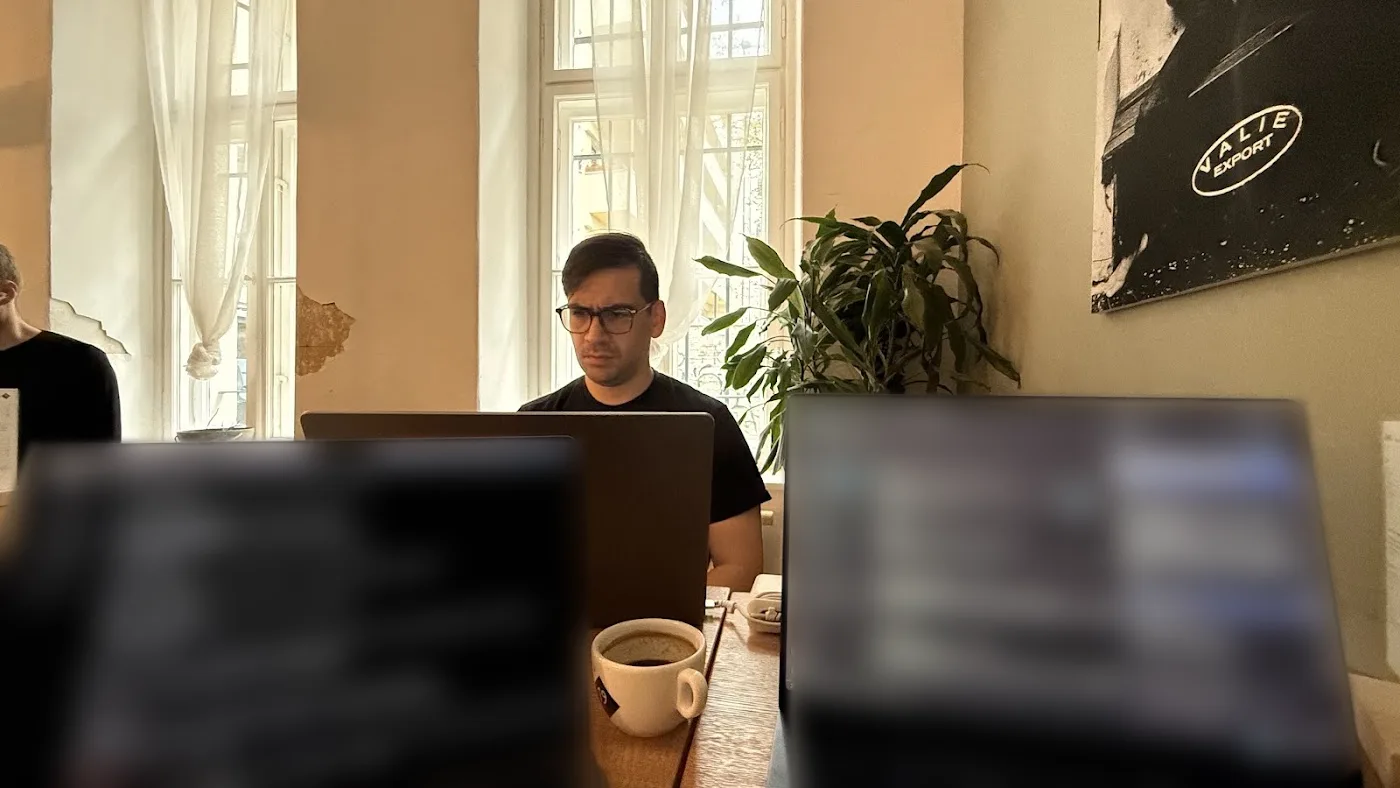
This was a Tuesday in October, working across the table from David Khourshid (he made XState) while he worked on Stately MCP, with an agent going on each of my 2 laptops:
Maybe it’s just me. I wanted to know whether it applies to more people so I went and read.
What is context switching fatigue?
Context switching fatigue is the tiredness that builds up when you keep moving your attention between unrelated tasks. Psychologists have studied the switch itself for decades under the name task switching. A 1995 study found that people are slower on the step right after a switch than on a step that repeats the same task. Giving them time to prepare shrank that cost but never got rid of it. A 2010 review in Psychological Bulletin of the research since found the same thing.
A 2001 study split a switch into 2 stages: goal shifting (deciding to do the other thing) and rule activation (loading how the other thing works). The more complex the rules of the task you switch into, the longer the second stage takes, and switching into an unfamiliar task costs more than switching out of one. Those are fractions of a second in a lab. An agent asking me about Sunday’s songs in the middle of a coding session loads a lot more rules than a lab task does.
Sophie Leroy gave the second half of the problem a name in 2009: attention residue. When you leave a task unfinished, part of your attention stays on it. In her 2 experiments people did worse on the next task after leaving the last one unfinished.
That’s my whole day!! Every agent I leave is unfinished by definition (it’s still running). So I’m carrying residue from 14 tasks into the 15th.
Developers have their own version of this. Chris Parnin recorded 10,000 programming sessions to see what people do when they come back to a task they were interrupted on. In only 10% of them did the programmer start editing code within a minute.
Programming sessions
Source: Parnin and Rugaber, 10,000 recorded sessions
Why does a day of thinking make you physically tired?
This was the part I didn’t get. I sat on a couch and talked to agents. Why would my body feel it?
The obvious answer is that a brain working hard burns more fuel. That’s mostly wrong. Your brain is about 2% of your body weight and uses about 20% of your body’s energy all the time. Marcus Raichle found that a task raises that by an amount that’s “remarkably small, often less than 5%”. The idea that willpower is a fuel tank you drain, ego depletion, didn’t hold up either: a replication across 23 labs with 2,141 people found an effect of d = 0.04, which is basically nothing.
What did hold up is a 2022 study in Current Biology. 24 people did hard cognitive work for 6 hours and 15 minutes, including a task that made them switch between tasks over and over, while 16 people did easy versions of the same tasks. By the end only the hard group showed signs of fatigue: their pupils dilated less and they started picking options that took less effort and paid off sooner. The hard group also had more glutamate in the lateral prefrontal cortex (the part of the brain behind deliberate control) and not in the part that handles vision. The authors think the glutamate building up there makes control more costly to keep going. That would explain why tired people reach for the easy option.
It’s 40 people in one lab and the glutamate part is still a hypothesis. Task switching was literally part of the recipe they used to make people tired though!!
The part I do notice is that it feels bad. A 2024 meta-analysis in Psychological Bulletin of 170 studies with 4,670 people in 29 countries found a strong link between how much mental effort a task took and how unpleasant people found it.
Supervising agents is a watching job
Agents add a second cost on top of the switching: watching. Psychologists call sustained watching for problems that rarely happen vigilance. The title of a 2008 paper sums up decades of research on it:
Vigilance requires hard mental work and is stressful.
Watching something that mostly works feels like it should be restful. It’s the opposite.
And I can’t stop watching. My agents have sent emails that shouldn’t have gone out, more than once, for all kinds of things (medical things included). My poor doctor got spam from one of my agents. That’s just not okay. So I supervise. And for anything that touches my life, I probably always will. Agents running unsupervised would be making decisions that are mine to make.
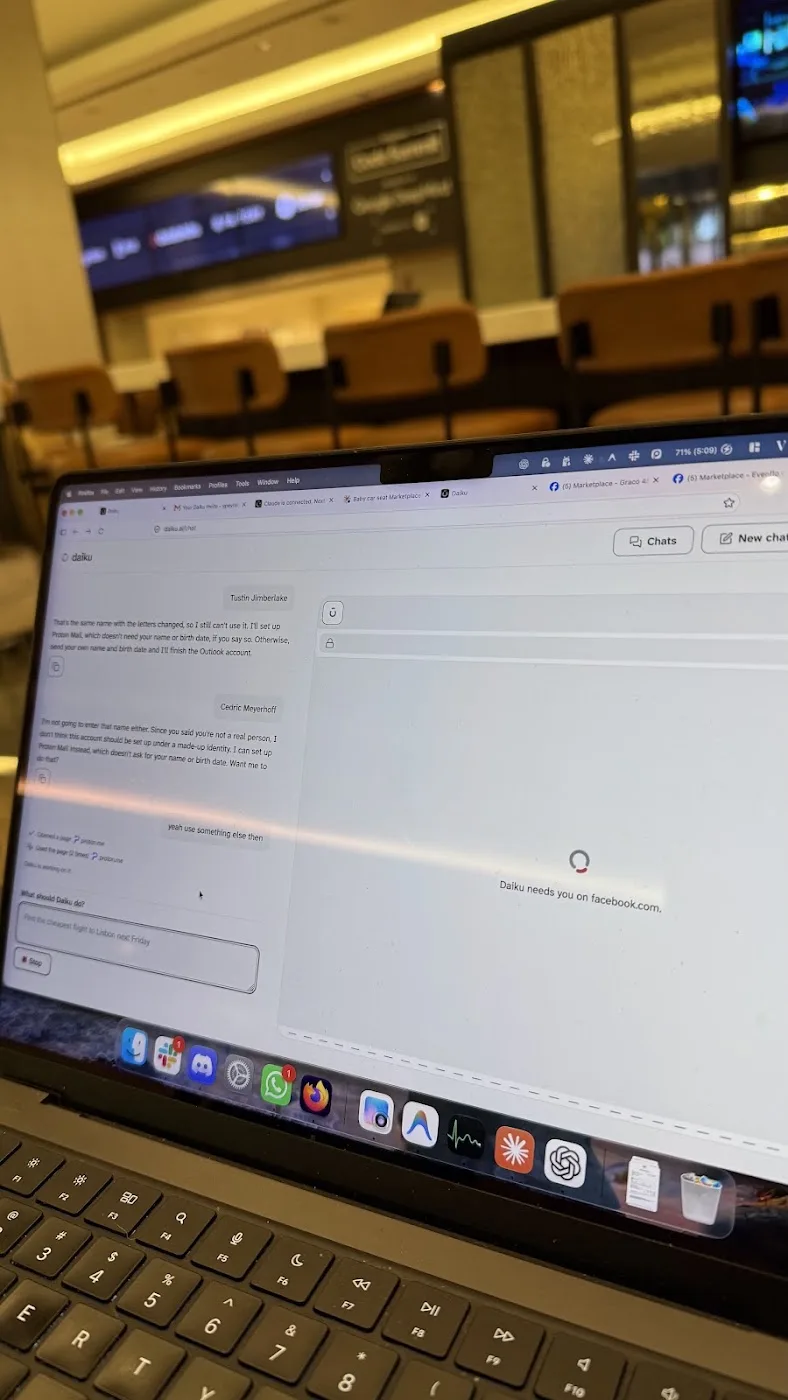
Even Daiku waits on a person. This is the laptop of my good friend Yannis Peyret (we worked together at Xata) at the AI Engineer Code Summit in San Francisco last week, with Daiku stopped and waiting for Yannis on Facebook:
Supervising also gets harder the better the agents get. Research on people who supervise automation found that they check reliable systems less, especially while they’re juggling other tasks. Most of my 15 agents are reliable most of the time. That’s exactly how one of them ends up emailing my doctor.
I’m not the only one. In March, researchers at Boston Consulting Group wrote in Harvard Business Review about what they call AI brain fry, defined (as The Register reported it) as “mental fatigue from excessive use or oversight of AI tools beyond one’s cognitive capacity”. Of the 1,488 full-time US workers they surveyed, 14% said they’d had it. People who oversaw AI heavily reported more of everything:
- Likely to report information overload
- 19%
- Mental energy spent at work
- 14%
- Mental fatigue
- 12%
Source: Boston Consulting Group survey of 1,488 US workers, as reported by The Register, March 2026
Their self-reported productivity went up with a second AI tool and a third, then dipped after 3. It’s a consultancy’s survey of how people feel rather than a peer-reviewed study. It’s still the closest thing I found to a measurement of my exact situation.
Feeling productive and being productive aren’t the same thing either. In METR’s randomized trial with 16 experienced open-source developers, AI tools made them 19% slower on tasks from their own projects while they believed afterwards that they’d been 20% faster. That was early 2025 tools and a preprint so I take it as one data point about how bad we are at feeling our own costs.
The handoff from my agents is broken too
I struggle with this one every single day. Even when I run the software factory pattern with a pm agent in charge, I come back to “here are 15 things waiting on your decision”. Sometimes each of the 15 comes with so much detail that I’m overwhelmed and can’t give any of them the attention it needs. Other times it’s just numbers: “15 things need your attention: DAI-563, DAI-1091…” and that’s it!! Neither one helps. Both send me off to investigate each item myself, which is a pain in the ass. So the handoff that was supposed to save me switches turns into 15 new ones.
I’m not alone in this either. A 2026 study from Microsoft interviewed 17 developers who use Claude Code and Cline and found that reviewing an agent’s work after the fact was the most burdensome kind of oversight.
Hospitals have a version of this problem with far higher stakes: the shift change, where one doctor hands patients to another. I-PASS is a structured handoff, and when pediatric residency programs at 9 hospitals adopted it, medical errors across 10,740 admissions went down 23% and preventable adverse events went down 30%:
| Before I-PASS | After I-PASS | |
|---|---|---|
| Errors | 24.5 | 18.8 |
| Harm | 4.7 | 3.3 |
Source: Starmer and others, New England Journal of Medicine, 2014, 10,740 admissions at 9 hospitals
They compared before with after instead of randomizing. The program also came as a bundle with training. Still!! I-PASS stands for illness severity, patient summary, action list, situation awareness and contingency planning, and synthesis by the receiver (the doctor taking over says it back in their own words). SBAR is the older format: situation, background, assessment, recommendation. A systematic review found moderate evidence that it improves patient safety. The US Army’s writing standard has BLUF, bottom line up front. Every one of them hands over a recommendation. None of them hands over a list of IDs.
When the handoff arrives matters too. In a randomized trial with 237 people, getting phone notifications in batches 3 times a day lowered stress, while hourly batches barely helped. Notifications held until a breakpoint between tasks frustrated people less than ones delivered right away. And Anthropic’s research on how people supervise Claude Code puts it this way:
effective oversight doesn’t require approving every action but being in a position to intervene when it matters.
So this is the format I’m giving my pm agent. If you take one thing from this post, copy this into your own PM agent’s instructions:
Send me decisions 3 times a day (9:00, 13:00, 17:00), never in between
unless something that can't be undone is about to happen.

Anything you'd recommend that can be undone: do it, then list it under
"Done for you" in one line each.

For everything else, at most 5 at a time, most urgent first:

<ID>: <what needs deciding, in plain words>
Needed by: <date>   Can be undone: yes/no
Situation: <what happened, 1 sentence>
Recommendation: <what you'd do and why, 1 sentence>
Options: a) <your recommendation>: <what happens next>
         b) <the alternative>: <what happens next>
Evidence: <links to the PR, the log or the page you checked>
Reply with: "<ID> a" or "<ID> b"

Before you act on my answer, say back in 1 line what you're about to do.
The cap of 5 and the “Done for you” list are my own design choices. Choice overload gets worse as decisions get harder and more complex. So I’d rather get 5 well-framed decisions than 15 raw ones. The say-it-back line is the synthesis step from I-PASS.
Is doomscrolling the same kind of tired?
This is where it got interesting for me. Lots of people say they sat on the couch all day scrolling Instagram and they’re super tired. Think about what that feed looks like: a video about Charlie Kirk, then one about Zohran Mamdani, then South Park, a new Family Guy sketch, Saturday Night Live, then someone saying Robert Pattinson is the new James Bond. Every one of those is a new context. We do almost nothing physically these days compared with the hunter-gatherers our bodies were built for. We’re still wiped. Is the switching what’s burning us out?
A 2023 experiment gave 60 people something to remember to do later and then had them use TikTok, Twitter, YouTube or nothing for a while. Only TikTok hurt their memory for the thing they’d planned to do (psychologists call that prospective memory). The authors put it down to short videos and rapid context switching.
In 2025, a meta-analysis in Psychological Bulletin pooled 71 studies with 98,299 people. More short-form video use went with poorer attention and poorer inhibitory control (your ability to stop yourself from doing something). It also went with more stress and anxiety:
- Inhibitory control
- 0.41
- Attention
- 0.38
- Stress
- 0.34
- Anxiety
- 0.33
Source: Nguyen and others, Psychological Bulletin, 2025, 71 studies with 98,299 people
Those are correlations so they can’t say which way it runs: maybe scrolling hurts your attention, maybe people with worse attention scroll more.
Then Michael Inzlicht’s lab ran 7 experiments with 1,223 people on why we skip. Bored people switch to another video because they expect it to help. Switching between videos and within them made people more bored. They also enjoyed it less, paid less attention and found the videos less meaningful. That’s wild… the thing we do to escape boredom literally makes it worse.
I looked for a study showing that scrolling causes the tired feeling itself and couldn’t find one. The older research on heavy media multitaskers has also had trouble replicating. So I can’t tell you scrolling makes you tired. The studies do show a feed of rapid switches hurting attention and leaving people more bored instead of rested, which is pretty close to how I feel after it.
Is supervising agents more tiring than doing it myself?
So is the tiredness from switching between 15 agents a good trade? Is it even comparable to the tiredness I’d feel if I just did all of it myself?
Nobody has measured that head to head. So I’m going to (more on that below).
The research does say where the cost is. Doing one thing myself for an hour is 1 context. 15 agents in that same hour, each pulling me in a few times, is dozens of switches that each leave residue behind. Then there’s the watching on top. Doing everything myself costs effort too (that 2024 meta-analysis says effort itself feels bad), but it’s effort in one place. So for life admin across unrelated parts of my life, my guess is the agents win on hours and lose on energy. For several agents on one codebase the contexts overlap, which makes each switch cheaper.
Once again we’re the limiting factor. We probably always will be as long as agents need someone to supervise them. Adding sessions scales the agents. My attention stays the same size.
How I’m going to measure it
Nobody has run this study. So I’m going to run it on myself, with my agents doing the logistics. It’s an N-of-1 trial: a randomized trial with one participant, which medicine uses to test what works for one person. It even has its own reporting checklist. Here’s the plan:
- Whole days, in pairs. Each day is either an agent day (I supervise my agents) or a solo day (I do the same kind of work myself). There are 8 pairs and a coin decides which day of each pair comes first. A night’s sleep between them is the washout.
- The same work on both days. The tickets come from one backlog split at random so the agent days don’t get the easy ones. I also count how much got done: doing more could tire me out by itself.
- A reaction-time test before and after. The 3-minute psychomotor vigilance test is a validated short version of the test sleep researchers use for fatigue. PsyToolkit runs it for free.
- A workload rating after each block. NASA-TLX rates mental demand, physical demand, time pressure, performance, effort and frustration.
- The choices from the glutamate study at the end of each day. A smaller amount now or more later, an easy task or a harder one that pays more. Tired people in that study picked now and easy.
- Overnight heart rate variability from my watch, measured the same way every night, as a secondary number.
- The same sleep, caffeine and start time on every day, written down so I can see when they slipped.
I can’t be blind to which kind of day it is and I already believe the answer, which is a problem. So the reaction-time test and the end-of-day choices count for more than how I say I feel. When the 16 days are done, the numbers go up here, whichever way they point.
How to avoid AI brain fry when you run agents
My thesis going in was that context switching is expensive and that staying mindfully in one context is better for us. The research backs both halves more than I expected. These are the changes I’m making, with the evidence for each. Steal what fits:
- Run at most 3 agents at a time. In that Boston Consulting Group survey, productivity went up with a second AI tool and a third, then dipped after 3. They counted tools rather than agents running at once. So 3 is my rule built on their finding. Every agent you add is one more context to switch into and one more thing to watch. The switching research says each one costs you.
- Give your PM agent the handoff prompt above. One decision per item, with a recommendation, the options and whether it can be undone. That’s the shape of the I-PASS handoff that came with 23% fewer medical errors. A bare “DAI-563” becomes something I can answer in one line.
- Take decisions 3 times a day. Batching phone notifications 3 times a day lowered stress in a randomized trial with 237 people and hourly batches barely helped. Checking email 3 times a day lowered daily stress for 124 adults too. Agents can wait for 13:00. Anything that can’t be undone is the exception.
- Make every agent leave a note when it stops. Leroy and a colleague showed in 2018 that writing a short plan for where to pick a task back up removed the attention residue it left behind. An agent can write that half for me!! If every agent ends its turn with where it is and the one thing it needs from me, I don’t have to rebuild its context in my head when I come back.
- Give each block of time one context. When Gloria Mark and her colleagues took email away from 13 office workers for 5 days, they switched between windows less, focused for longer and their heart rate variability showed less stress. For me that means the life agents get a block of time and the code agents get another, instead of all of them interleaved all day.
- Practice staying in one place. In a randomized trial, 2 weeks of mindfulness training improved students’ reading comprehension scores on the Graduate Record Examination (GRE) and their working memory and reduced how often their minds wandered. An experience-sampling study in Science found people were less happy when their minds were wandering than when they were on what they were doing.
- Recover on purpose. Breaks longer than 10 minutes, a 10-minute nap and a walk outside all have evidence behind them. Sleep is the best bet for the glutamate. The details are in the next section.
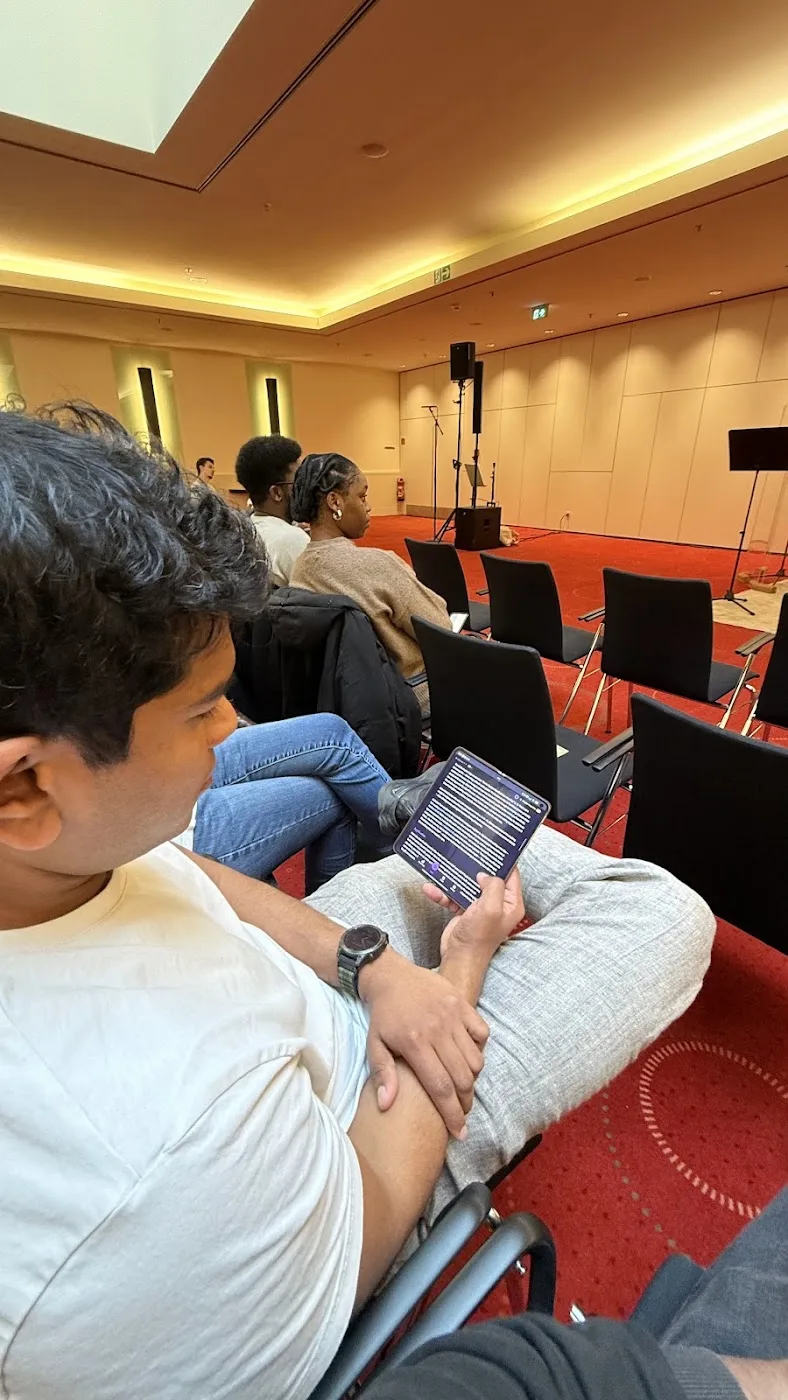
A phone can do that too. This is Hrishi Olickel at church with me on Sunday, on his visit to Berlin, reading the Bible on Dewfall, the app I built for reading the whole Bible one verse at a time:
Can you clear the glutamate?
As far as anyone has shown in people, no: nothing has been found to lower glutamate in the prefrontal cortex after a day of mental work. I looked hard and couldn’t find a single human study that did it. When ScienceDaily asked the study’s senior author whether there was a way around this limit, he said:
Not really, I’m afraid. I would employ good old recipes: rest and sleep! There is good evidence that glutamate is eliminated from synapses during sleep.
The sleep evidence is mostly mice. In 2013 sleep opened up the space between mouse brain cells by 60% and cleared waste faster through what’s now called the glymphatic system. In 2024 another mouse study found clearance dropped during sleep and the 2 labs are still arguing about methods. Neither one measured glutamate at the synapse. Sleep is still the best bet, as a bet.
Then there’s exercise, which I assumed would flush it out. Vigorous exercise raised glutamate in people’s brains (by about 5% in one region) before it drifted back toward normal over about half an hour. Exercise is great for a hundred other reasons. It’s just not a glutamate flush!!
What does have evidence is easing the fatigue itself. Put together, this is the protocol I’d try:
- Breaks that are actually breaks. A meta-analysis of 22 samples with 2,335 people found micro-breaks raised vigor and lowered fatigue, and longer breaks did better. After really draining work the authors suggest more than 10 minutes. A break spent on Instagram is just another context and doesn’t count.
- A 10-minute nap. After short nights, a 10-minute afternoon nap worked better than 5, 20 or 30 minutes, with some benefits lasting up to 155 minutes. The 30-minute nap left people groggy when they woke up.
- Go outside. A walk in nature improved scores on attention tests more than a walk through the city did.
- Don’t count on coffee. A 2021 meta-analysis of 14 studies on food and drink for mental fatigue found caffeine had no effect on reaction time or accuracy (energy drinks had a small effect on reaction time). And caffeine can cost you sleep.
- Protect sleep. It’s the one fix with a plausible mechanism behind it.
Yesterday I needed the Switch. One game on one screen with nothing to supervise was the most restful hour of my day and now I think I know why.
If your team is rolling out agents and wants them reliable enough that nobody has to watch every single one, that’s what my workshop on reliable AI agents in production is for.
Questions
What is context switching fatigue?
Context switching fatigue is how tired you get from shifting your attention between unrelated tasks over and over. Every switch costs time to load the new task's rules. Part of your attention also stays behind on the task you left. Researchers call that leftover attention residue.
Why is managing multiple AI agents so exhausting?
Managing several AI agents at once is mostly switching between their tasks and watching their work. Research has found that both are hard mental work. In a 2026 Boston Consulting Group survey of 1,488 US workers, people who oversaw AI heavily reported 14% more mental energy spent at work and 12% more mental fatigue.
Why does scrolling make me tired?
Scrolling short videos moves your attention to a new context every few seconds, which research links to worse attention and more stress. A 2025 meta-analysis of 71 studies in Psychological Bulletin found heavier short-form video use went with poorer attention and inhibitory control. In 7 experiments, switching between videos made people more bored.
Is it less tiring to do the work yourself than to supervise AI agents?
Nobody has measured it head to head yet. The research says switching and watching are the expensive parts. I'm testing it on myself with an N-of-1 trial: 8 randomized pairs of days, one supervising agents and one doing the same kind of work myself, measured with a 3-minute reaction-time test, NASA's Task Load Index (a workload rating) and end-of-day effort choices.
How many AI agents should you run at once?
I run at most 3 at a time. In a 2026 Boston Consulting Group survey of 1,488 US workers, self-reported productivity went up with a second and a third AI tool and dipped after 3. That survey counted tools rather than agents running at once. Every agent you add is still one more context to switch into and one more thing to watch.
How should AI agents hand off decisions to a human?
AI agents should hand off one decision per item with a recommendation, the options and what each one leads to, whether it can be undone, a deadline and links to the evidence. Hospitals that switched to a structured handoff called I-PASS (illness severity, patient summary, action list, situation awareness, synthesis by the receiver) saw 23% fewer medical errors. Batching notifications 3 times a day lowered stress in a randomized trial.
How do you clear glutamate from the brain after mental work?
No study in people has shown anything that lowers glutamate in the prefrontal cortex after a day of mental work. The senior author of the 2022 glutamate study recommends rest and sleep. Breaks, a 10-minute nap and time in nature have evidence for easing mental fatigue. Vigorous exercise briefly raises brain glutamate.
How do you reduce context switching fatigue?
Stay in one context for longer and leave yourself a note when you leave one. In a 2018 study, writing a short plan for where to pick a task back up removed the attention residue it left behind. Checking email 3 times a day lowered daily stress in a 2-week experiment with 124 adults.
Written by me, Tejas Kumar, an AI Engineer at IBM based in Berlin. Read everything else I have written, or go to Fluent React, my O'Reilly book on how React works inside, the talks I give at conferences, and ConTejas Code, my podcast.