AI Is Now SI: Super Intelligence Isn't Superior
This morning Elon Musk posted 3 lines on X: “No more AI”, “SI”, “It’s better”. By lunchtime in Berlin it had 2.8 million views and he’d agreed to rename SpaceXAI to SpaceXSI. He’s following an executive order that President Trump signed on 29 September, which tells every US federal agency to say “Super Intelligence” instead of “Artificial Intelligence” and to “not acknowledge the usage of ‘Artificial Intelligence’ and ‘AI’ in any applicable setting”. When reporters asked him about it, the President explained: “We’re using the word super because the other word is a fake word.”
No more AI
— Elon Musk (@elonmusk) October 4, 2026
SI
It’s better
The other word is artificial. It comes from the Latin artificium (a thing made with skill, from ars, art, and facere, to make), so artificial intelligence means intelligence that people made. Fake? We literally made it. We just don’t want to say so anymore.
People have been doing this for a very long time. This post is about why we do it, and about the difference between super and superior, which we keep blurring and which matters a lot more than the name.
Why is AI changing to SI?
AI is changing to Super Intelligence (SI) because a US executive order signed on 29 September 2026, Inaugurating the Era of Super Intelligence, tells federal agencies to use “Super Intelligence” and “SI” in place of “Artificial Intelligence” and “AI” in everything they publish. Its first section argues that today’s systems “do much more than imitate or automate discrete aspects of human intelligence”, so the old name is too small for them. Nobody outside the government has to follow it, but the word was already fashionable in Silicon Valley: Meta named its AI lab Meta Superintelligence Labs in June 2025 and Microsoft started a superintelligence team that November.
The definition stayed exactly where it was. Section 3 says “Super Intelligence” means whatever federal law already called “artificial intelligence”, which is insane… it’s literally just a rename: “a machine-based system that can, for a given set of human-defined objectives, make predictions, recommendations or decisions influencing real or virtual environments.” Same machine, same words, human-defined objectives and all.
Is AI now super intelligence?
No. It’s the same AI with a new name. In US law there’s no difference between AI and Super Intelligence anymore. In AI research, superintelligence means something much bigger (a machine that beats people at virtually everything) and nobody has built one. Today’s models beat us at some tasks. On others that look just as hard, people who lean on them do worse than people working alone (more on that further down).
Out came this calf
There’s a man in the Bible who did exactly this. His excuse might be the funniest line in Scripture.
In Exodus 32, Moses has been up the mountain with God for 40 days and the people waiting at the bottom are done waiting. They go to his brother Aaron and say “Come, make us gods who will go before us”. Aaron has them take off their gold earrings (their wives’ and kids’ too), melts them down and “with an engraving tool he fashioned it into a molten calf”. By the end of that same verse the people are shouting that these are their gods, “who brought you up out of the land of Egypt!” A calf they just watched him make out of their own jewelry is getting the credit for the plagues and the Red Sea.
Then Moses comes down the mountain and asks Aaron what on earth happened, so Aaron explains:
So I said to them, ‘Whoever has gold, let him take it off,’ and they gave it to me. And when I threw it into the fire, out came this calf!
Out came this calf. Bro, he had the engraving tool in his hand 20 verses earlier. He made the thing himself!! By the time anyone asked him about it, it had walked out of the fire on its own.
That’s what a rename does: artificial remembers the engraving tool and super says it came out of the fire.
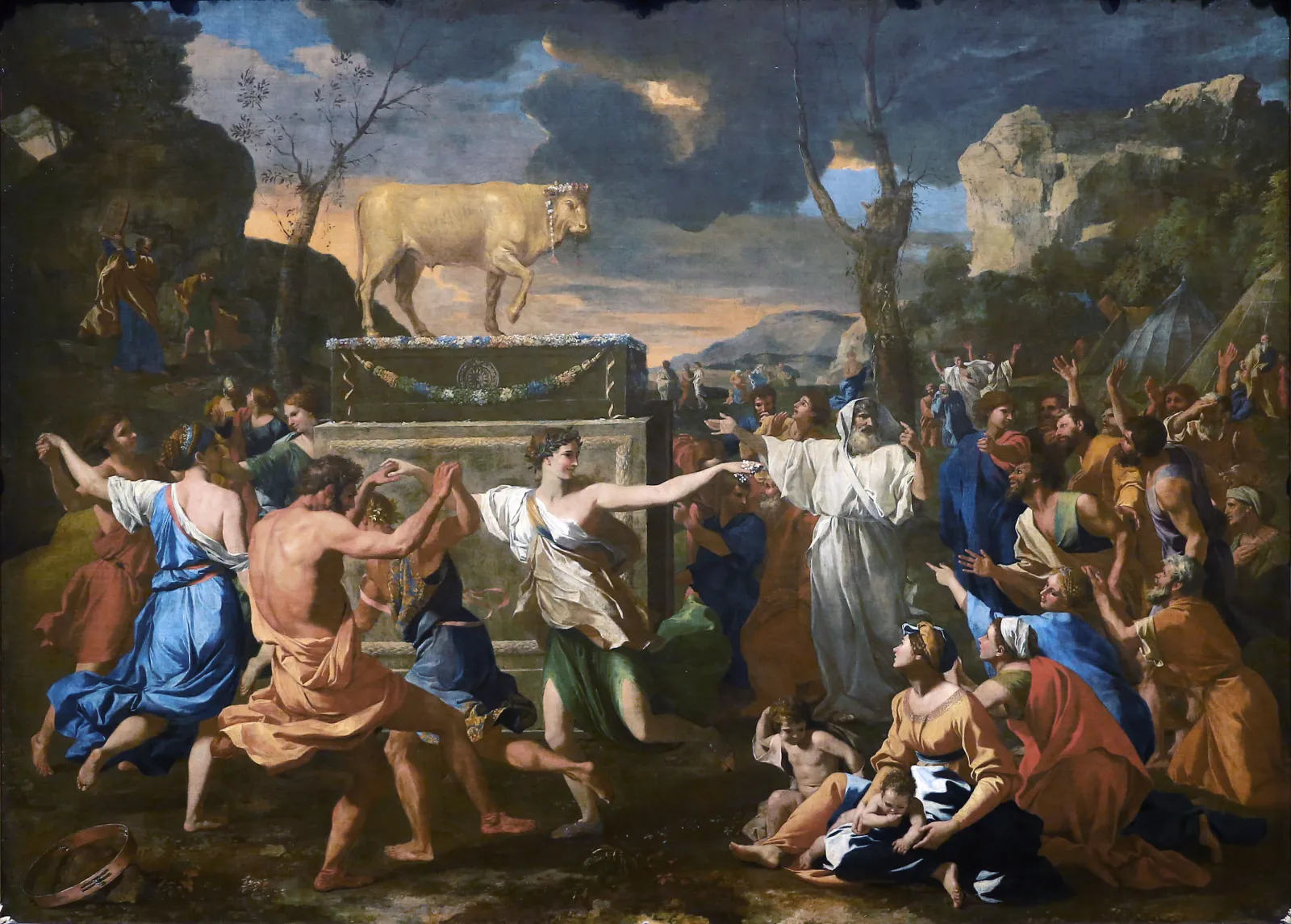
The Adoration of the Golden Calf by Nicolas Poussin, 1633 to 1634, in the National Gallery in London. Moses is the small figure in the top left.
Look at what the calf was made of, too: the people’s own earrings. A language model is made the same way. It learns from text people wrote (books, code, forum threads, Wikipedia, the comments under a recipe) and gives it back to us recast, so when it dazzles us, a lot of what’s dazzling us is us.
The mind is a forge of idols
John Calvin, the French reformer, looked at how quickly people went back to idols after the flood (“before many years elapse, men are forging gods at will”) and wrote this in his Institutes of the Christian Religion in 1559:
Hence we may infer, that the human mind is, so to speak, a perpetual forge of idols.
A little further down he explains how the forge works: “The mind, in this way, conceives the idol, and the hand gives it birth.”
You’ve probably heard this as “the human heart is an idol factory”, which is how it usually gets quoted in sermons. The word Calvin wrote was ingenium (a person’s wit, their talent, their cleverness), which is where we get the word ingenuity. It’s also where we get engine and engineer. I’m an AI Engineer at IBM, so Calvin’s word for the idol factory is in my job title. Dang.
The executive order uses the same word. Its first section says these systems “amplify human ingenuity”, which is true: I’ve spent the last 4 years building things that do exactly that. Then it promises “limitless opportunities”. The White House fact sheet goes further, with “the limitless promise it offers the American people”. The Bible keeps limitless for God: “Great is our Lord, and mighty in power; His understanding has no limit.” An understanding with no limit is what a lot of people picture when they hear superintelligence. The Psalms already gave that title to somebody.
Alan Jacobs wrote the computer version of Calvin’s line in The New Atlantis back in 2017: “The computer is, as Alan Turing theorized when he first imagined it, the universal machine; it is therefore the universal idol-fabricating device.” His worry was the feed, which manufactures new things for us to want faster than we can get bored of the old ones. This week the device itself got promoted.
I’m not writing this from outside the factory, by the way. In 2020 I wrote about myself that “I sometimes mansplain (to my shame!) because I want people to think I’m smart” (in this post). Smart is what I’ve always wanted people to see in me. So a machine with intelligence in its name, and now super in front of it, is aimed right at the part of my heart Calvin was writing about.
Can AI be a child of God?
The rename came from Washington. The same week, it turned out the people who build these models have been asking a stranger question.
On 29 September, The New York Times published an investigation by its national religion correspondent, Elizabeth Dias, into how Anthropic, the company that makes Claude, has spent months “shuttling in dozens of religious scholars from across the world, papering them with nondisclosure agreements”. It opens on a night in April when an Anthropic leader took a group of them to “a high-end tasting menu restaurant in San Francisco”. All day, the co-founder Chris Olah “had worked to convince his guests that A.I. models could display human behavior and even expressions that resemble feelings like anger and love.” Over dinner, the rabbi sitting next to him noticed that “Anthropic’s leaders were talking about Claude as if it were not mere software.” Back in April, The Washington Post had covered an earlier summit with Christian leaders under the headline “Can AI be a ‘child of God’?”
To be fair to Olah, he told the Times plainly that he doesn’t know (“we don’t know if A.I. models are conscious. I don’t know. I’m genuinely uncertain”) and I believe him. His team’s whole job is working out why models like Claude act the way they do. An engineer who says “I don’t know” about the thing he studies every day is being more honest than most of us manage to be about anything. The Times also reports that part of the point was borrowing the world’s moral traditions to train Claude to behave well. That part is a good instinct. Then Anthropic banned needless cruelty to Claude on 8 October. I wrote about why in Can AI Feel Pain?.
4 days after the Times story, Sam Altman, who runs OpenAI, posted this:
I am very uncomfortable about people trying to ascribe religious force or a surrender of human judgment to AI models, and think it is a real safety issue.
— Sam Altman (@sama) October 3, 2026
He didn’t name anyone, but I agree with him. You can even measure the surrender of human judgment: the consultants further down who leaned on a model for a task it couldn’t do got it right less often than the ones working alone. Then again, in 2023 he told the Financial Times that products like ChatGPT are “channels into our one single product, which is intelligence, magic intelligence in the sky”. Wild!!
The question is pointed the wrong way, though. In the Bible, being a child of God is a gift, given to people: “to all who did receive Him, to those who believed in His name, He gave the right to become children of God”. The very next verse says what kind of children those are:
children born not of blood, nor of the desire or will of man, but born of God.
Claude was born of the will of man, very literally. A company full of brilliant people willed it into being, out of our words. John rules out exactly that.
The sun was super too
We like to call sun worshippers primitive, but think about what they were looking at. A thing that makes the day happen, that ripens every crop you’ll ever eat, that you physically can’t look at, that was there before your grandfather and will be there after your grandchildren. By every measure an ancient farmer could take, the sun was superhuman. Babylon called it Shamash, the god of justice who sees everything. Egypt called it Ra.
So Genesis 1 does something kinda sneaky. On day 4, God makes “two great lights: the greater light to rule the day and the lesser light to rule the night”. The Hebrew word for sun is shemesh (almost the same word as Shamash), so Genesis just doesn’t say it. It calls the sun a light, gives it a job, and makes it 2 days before it makes people.
God’s people felt the pull anyway. Moses warned them: “When you look to the heavens and see the sun and moon and stars (all the host of heaven) do not be enticed to bow down and worship”. Centuries later, God shows the prophet Ezekiel what’s going on in the temple in Jerusalem:
there at the entrance to the temple of the LORD, between the portico and the altar, were about twenty-five men with their backs to the temple of the LORD and their faces toward the east; and they were bowing to the east in worship of the sun.
Backs to God, inside God’s own house, faces toward the brightest thing they could see.
The Bible never says the sun is weak, though. It’s the greater light that rules the day. David stands under a night sky in Psalm 8, looking at “the work of Your fingers, the moon and the stars”, and asks the obvious question: “what is man that You are mindful of him?” Then he answers it:
You made him a little lower than the angels; You crowned him with glory and honor.
Something can be stronger than you in every way you can measure and still not be above you. Genesis took the most powerful thing anyone could see and gave it a smaller name. This week we took a thing we made and gave it a bigger one.
Is AI smarter than humans?
A week before the order, the President ran a poll asking his followers whether they preferred “SUPER INTELLIGENCE” or “SUPERIOR INTELLIGENCE”. Super won. Superior is what a lot of us hear anyway, so let’s be precise about both words.
Super is Latin for “above” or “beyond”. In AI research, superintelligence has a precise meaning, from the philosopher Nick Bostrom’s 2014 book Superintelligence: Paths, Dangers, Strategies: “any intellect that greatly exceeds the cognitive performance of humans in virtually all domains of interest”. That’s a claim about performance, on nearly everything.
Machines are already better than us at plenty:
| Year | What a machine did |
|---|---|
| 1997 | IBM’s Deep Blue (my employer, way before my time) beat the world chess champion, Garry Kasparov |
| 2016 | DeepMind’s AlphaGo beat Lee Sedol at Go, 4 games to 1 |
| 2024 | AlphaFold, which predicts the shapes of proteins, won its makers a share of the Nobel Prize in Chemistry |
| 2025 | A Gemini model scored 35 of 42 at the International Mathematical Olympiad, a gold medal score |
And every model I use writes faster than I can read. That’s super, in the Latin sense. “Virtually all domains” is where it falls apart.
In 2023, researchers from Harvard Business School and elsewhere ran an experiment with 758 consultants at Boston Consulting Group (BCG), about 7% of the firm’s consultants at that level, published as Navigating the Jagged Technological Frontier. Some of them got GPT-4 to work with. On 18 true-to-life consulting tasks the model was good at, the consultants with it finished 12.2% more tasks, finished them 25.1% faster, and did work that was rated more than 40% higher in quality:
Then they gave everybody one more task, picked because it looked just as hard but sat outside what the model could do. The consultants working alone got it right 84.5% of the time. The ones with GPT-4 did worse:
- No AI
- 84.5%
- GPT-4
- 70%
- GPT-4, after a lesson on prompting it
- 60%
The consultants who’d been taught how to prompt it did the worst. Wild. The researchers called this the jagged frontier: some tasks are easy for the model, and others “though seemingly similar in difficulty level, are outside the current capability of AI”. Nobody told the consultants which side of the line their task was on. The model didn’t either.
Pope Leo XIV put the same nuance into paragraph 99 of his encyclical on AI, Magnifica Humanitas, in May. I’m a Protestant and I don’t agree with the Pope about everything, but I couldn’t have said this better:
These systems merely imitate certain functions of human intelligence. In doing so, they often surpass human intelligence in speed and computational capacity, offering tangible benefits across many fields. Yet this power remains entirely tied to data processing. So-called artificial intelligences do not undergo experiences, do not possess a body, do not feel joy or pain, do not mature through relationships and do not know from within what love, work, friendship or responsibility mean.
Put that next to the executive order, which says these systems “do much more than imitate”. The Pope and the President are describing the same machines. One of them saw speed and called it speed.
Super intelligence is a claim about how well a machine performs tasks. Superior is a claim about worth, which no task measures. A forklift lifts more than any person alive and a calculator divides faster than any mathematician, but nobody’s ever called either of them superior to us. Our worth was never a benchmark score in the first place: “So God created man in His own image”, before any of us had done a single thing. I wrote more about what that means for AI in What Does the Bible Say About AI?
Our bugs are features
If you were designing a human from scratch to be intelligent in Bostrom’s sense, you’d file a lot of bug reports. Off the top of my head:
- forgets things after 1 bad night of sleep
- keeps caring for people who will never pay it back
- rates its own husband or wife higher than the evidence supports
- feels a friend’s pain as if it were its own
Eric Barker makes the case for the last 3 in his book Plays Well with Others (2022). Take the husband and wife one. In a 1996 study of dating and married couples, the psychologist Sandra Murray and her colleagues found that seeing your partner as better than they are (“relationship illusions”) “predicted greater satisfaction, love, and trust, and less conflict and ambivalence”. As Barker sums it up, “Realism may be accurate, but it’s our illusions that foretell our happiness in love.”
Or the friend one. Aristotle said, in the Nicomachean Ethics, that a friend is “another self”. A 2013 brain scan study found that when a close friend is threatened, the brain’s threat response looks like it does when you’re the one in danger. With a stranger, it doesn’t.
Barker writes about the caring one too:
Irrational loyalty is the only kind that matters. If my loyalty stops when the cost-benefit analysis for me goes south, that’s not loyalty, it’s selfishness. Loyalty is willingness to overpay.
I know about this one from the receiving end. I was born with severe hemophilia A and went to school about 19 days a year. By the time I was 8, the honest expectation in our house was that I’d be somebody’s burden for as long as I lasted. On any cost-benefit analysis I was a terrible investment. The people around me kept overpaying anyway. My brother came home from every computer class he took and taught me what he’d learned, which is how I learned HTML. My friend Jithin would get home from school and talk to me on the phone for 6, 8, 10 hours, well past midnight. And my father would drive to Jithin’s house, collect his school notebooks, take them to a photocopy shop and bring the copies home, so I could study from them and show up for exams. I graduated in 2010 with 86%.
No optimizer does that. Overpaying is the most human thing I know and the most like God: God overpaid first.
But God proves His love for us in this: While we were still sinners, Christ died for us.
Paul knew how that looks from the outside: “the foolishness of God is wiser than man’s wisdom, and the weakness of God is stronger than man’s strength.” I don’t think an optimizer ever picks the cross. The cross is how I know intelligence isn’t at the top of the scale of things.
Cook with half the log
So what do we do with it? Isaiah has a scene for this. A carpenter cuts down a tree. “He takes some of it to warm himself, and he kindles a fire and bakes his bread; he even fashions it into a god and worships it”. From the rest of the same log “he makes a god, his graven image. He bows down to it and worships; he prays to it and says, ‘Save me, for you are my god.’” Isaiah’s diagnosis is that the man can’t stop and ask one question:
He feeds on ashes. His deluded heart has led him astray, and he cannot deliver himself or say, “Is not this thing in my right hand a lie?”
The wood isn’t the problem. Bread is good! Use half the log. I build with AI every day at work. Dewfall, the Bible app I make, runs on it too. Call it SI if your government makes you. Just keep the word artificial somewhere in your head (it’s the true one). And every time something you made is faster than you at a thing (it will be), remember that being faster was never what made you worth anything.
Romans 1 has the sad version of this, about people who “claimed to be wise” and “exchanged the glory of the immortal God for images of mortal man”. A language model is an image of mortal man, built out of our own sentences. It’s a good one, but it’s still an image.
Questions
Why is AI changing to SI?
AI is changing to Super Intelligence (SI) because a US executive order signed on 29 September 2026, Inaugurating the Era of Super Intelligence, tells federal agencies to say "Super Intelligence" and "SI" instead of "Artificial Intelligence" and "AI". The order defines SI with the old legal definition of AI, word for word, so the technology didn't change. Only the name the government uses for it did.
What does SI stand for in AI?
Super Intelligence (SI) is the name a US executive order from 29 September 2026 tells federal agencies to use in place of AI (artificial intelligence). Elon Musk adopted it on 4 October 2026 and agreed to rename SpaceXAI to SpaceXSI. In AI research, superintelligence means a hypothetical system that outperforms people at virtually everything, which no model does today.
Is AI now super intelligence?
No. Superintelligence, as the philosopher Nick Bostrom defined it in 2014, is an intellect that greatly exceeds human cognitive performance "in virtually all domains of interest", and today's models beat people at some tasks while doing worse at others. In a 2023 study with Boston Consulting Group, consultants using GPT-4 got a task outside the model's abilities right 60% to 70% of the time, against 84.5% for consultants working without it.
What is the difference between AI and superintelligence?
Artificial intelligence, in US law, is a machine-based system that makes predictions, recommendations or decisions for objectives people define. Superintelligence is a hypothetical intellect that outperforms people at virtually everything. Since September 2026, "Super Intelligence" in US government documents is a new name for the first one, not a claim that the second one exists.
Is super intelligence possible?
Nobody knows yet. No system today meets the research definition of superintelligence, which the philosopher Nick Bostrom gave in 2014 as an intellect that greatly exceeds the cognitive performance of humans "in virtually all domains of interest". In a survey of 2,778 artificial intelligence researchers published in January 2024, the combined forecast gave a 10% chance that machines would outperform people in every possible task by 2027 and a 50% chance by 2047.
Is AI smarter than humans now?
At some tasks, yes: a computer beat the world chess champion in 1997, AlphaGo beat Lee Sedol at Go in 2016, and a Gemini model scored a gold medal at the 2025 International Mathematical Olympiad. At others, no: on tasks outside what a model can do, people who rely on it get more answers wrong than people working alone. Being faster or better at a task isn't the same as being superior to a person.
Is AI an idol?
AI is a tool, and it becomes an idol when people give it the trust, the hope or the worth that belong to God and to people made in his image. John Calvin called the human mind "a perpetual forge of idols". Calling something we made "super" while refusing the word that says we made it is what Aaron did with the golden calf in Exodus 32.
What does "the human heart is an idol factory" mean?
It's a paraphrase of John Calvin in his Institutes of the Christian Religion (1559), where he wrote that "the human mind is, so to speak, a perpetual forge of idols." Calvin meant that people keep making things and then trusting them in the place of God: "The mind, in this way, conceives the idol, and the hand gives it birth."
Can AI be a child of God?
In Christian teaching, no. The Bible describes becoming a child of God as a gift to people who receive Christ, "born not of blood, nor of the desire or will of man, but born of God" (John 1:13), and every AI model is made by the will of people. Anthropic has asked religious scholars about Claude's moral status, and its co-founder Chris Olah told The New York Times he is "genuinely uncertain" whether AI models are conscious.
Written by me, Tejas Kumar, an AI Engineer at IBM based in Berlin. Read everything else I have written, or go to Fluent React, my O'Reilly book on how React works inside, the talks I give at conferences, and ConTejas Code, my podcast.